
Play Rise of Olympus Now!
Home → Similar Games
Games Similar to Rise of Olympus
Games close to Rise of Olympus
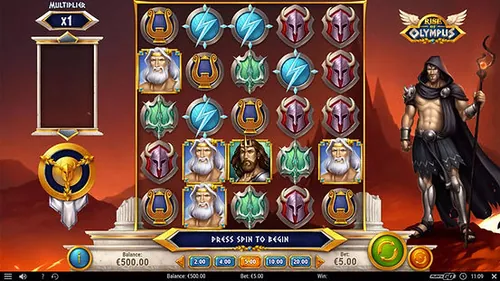
The 5x5 reel layout and Cluster Pays mechanic define the core structure of Rise of Olympus, distinguishing it from traditional payline slots. This grid format allows for simultaneous wins across multiple adjacent symbols rather than fixed lines, creating a denser payout potential on every spin. High rollers benefit from this design as it supports rapid stake accumulation without the need for complex betting systems or side bets.
Book of Dead utilizes a standard 5x3 reel setup with 10 fixed paylines, offering a stark contrast to the cluster-based mechanics found in Rise of Olympus. While both titles share the same maximum win cap of 5000x, the path to triggering bonus features differs significantly between the two formats. Players accustomed to linear paylines may find the cluster mechanic of Rise of Olympus requires a different strategic approach to bankroll management.
Legacy of Dead also employs a 5x3 reel layout similar to Book of Dead, maintaining a traditional slot experience that diverges from the modern grid structures. Both Legacy of Dead and Rise of Olympus share an identical maximum win potential of 5000x, yet their underlying volatility profiles dictate distinct risk curves. The higher frequency of small wins in legacy formats contrasts with the all-or-nothing nature of cluster drops.
Titles with similar maths
Rise of Olympus features a theoretical return to player (RTP) of 96.50%, which establishes a house edge of exactly 3.50% over extended play sessions. This percentage represents the long-term average return over hundreds of thousands of spins, serving as a baseline for mathematical expectation rather than short-term results. High rollers utilizing this game must account for the 3.50% statistical disadvantage when calculating expected value per hour of gameplay.
Reactoonz offers an RTP of 96.51%, providing a marginally lower house edge compared to the 3.50% found in Rise of Olympus. Although Reactoonz operates on a larger 7x7 grid, its mathematical model delivers a nearly identical return profile, making it a suitable alternative for players seeking comparable long-term yields. The 0.01% difference is negligible for most strategies but highlights the precision required when comparing high-stakes titles.
Tome of Madness presents an RTP of 96.59%, which exceeds the 96.50% return of Rise of Olympus by a measurable margin. This slightly higher return figure translates to a reduced house edge, offering mathematically favorable conditions for players engaging in extended sessions. Despite the superior RTP, Tome of Madness caps its maximum win at 2000x, limiting the upside potential compared to the 5000x ceiling of Rise of Olympus.
Same studio alternatives
Play'n GO developed Rise of Olympus, releasing the title in 2019 with a focus on Greek mythology and innovative cluster mechanics. The studio maintains a consistent technical standard across its portfolio, ensuring that games like Reactoonz share similar engine capabilities and mathematical rigor. High rollers familiar with Play'n GO's ecosystem can expect uniform performance characteristics and reliability across these distinct titles.
Reactoonz, another creation from Play'n GO, utilizes a 7x7 grid layout while maintaining a high volatility profile similar to Rise of Olympus. Both games emphasize cascading reels and multiplier features, though Reactoonz lacks a specific max win cap listed in standard comparisons. The shared developer ensures compatible user interfaces and transaction speeds, facilitating seamless transitions for players managing multiple accounts.
Book of Dead stands as a flagship title from Play'n GO, contrasting sharply with Rise of Olympus through its traditional 5x3 payline structure. While both games deliver a maximum win of 5000x, the mathematical distribution of payouts differs due to the fundamental mechanical divergence. Players switching between these titles must adjust their stake sizes to accommodate the varying hit frequencies inherent to each design philosophy.
Comparable volatility
Rise of Olympus exhibits high volatility, meaning payouts occur less frequently but tend to be larger when they do trigger. This characteristic aligns with the preferences of high rollers who possess the bankroll depth to withstand extended dry spells in pursuit of significant multipliers. The increasing multiplier on consecutive drops amplifies this volatility, potentially leading to substantial wins after periods of low activity.
Legacy of Dead shares the high volatility classification of Rise of Olympus, indicating a similar risk-to-reward ratio despite differing mechanics. Both titles require players to endure longer intervals between wins, necessitating a bankroll strategy that accounts for significant variance in short sessions. The alignment in volatility ensures that experienced players can apply consistent staking plans across both platforms without adjusting risk parameters drastically.
Tome of Madness maintains a high volatility rating comparable to Rise of Olympus, ensuring a consistent pacing of risk for analytical players. While the maximum win cap of 2000x is lower than the 5000x limit of Rise of Olympus, the frequency and size of intermediate wins remain statistically aligned. This similarity allows high rollers to substitute one title for another during peak hours without altering their overall session expectations.
Comparable return figures
The 96.50% RTP of Rise of Olympus positions it competitively against other high-volatility slots within the same genre. This figure indicates that for every 100 units wagered, the game theoretically returns 96.50 units over an infinite number of spins. High rollers must recognize that this return is a long-term average and does not guarantee profitability or loss prevention in individual gaming sessions.
Rise of Olympus 100 offers a slightly lower RTP of 96.20%, representing a 0.30% decrease compared to the original version. This reduction increases the house edge, making the original Rise of Olympus mathematically more favorable for players focused on minimizing long-term losses. The trade-off involves a higher maximum win potential of 15,000x, which appeals to those prioritizing jackpot size over statistical efficiency.
Reactoonz provides an RTP of 96.51%, exceeding the 96.50% return of Rise of Olympus by a minimal 0.01% margin. This near-identical return figure suggests that both games offer equivalent mathematical fairness, allowing players to choose based on aesthetic preference rather than yield. The marginal difference is insufficient to justify shifting bankroll allocation solely for return optimization purposes.
Rise of Olympus compared with similar titles
| Game | Studio | RTP | Volatility | Max win |
|---|---|---|---|---|
| Rise of Olympus | Play'n GO | 96.50% | high | 5000x |
| Alles Spitze | Merkur (developed by edict e-gaming under the Merkur/Gauselmann brand) | 90.85% | high | 500x |
| Book of Dead | Play'n GO | 96.21% | high | 5000x |
| Big Bass Splash | Pragmatic Play | 96.71% | high | 5000x |
| Le Cowboy | Hacksaw Gaming | 96.28% | medium | 25000x |
| The Dog House Megaways | Pragmatic Play | 96.55% | very high | 12305x |
| Wild Bounty Showdown | PG Soft (Pocket Games Soft) | 96.75% | medium | 5000x |
How these titles differ
Rise of Olympus utilizes a 5x5 reel layout with Cluster Pays mechanics, distinguishing it from Reactoonz 2 which employs a larger 7x7 grid for its cascading symbols. The compact grid size concentrates the action into fewer potential winning combinations per spin compared to the expanded play area of the competitor. This structural difference impacts the frequency of cluster formations and the overall pacing of the bonus features.
The Greek mythology theme sets Rise of Olympus apart from Le Cowboy by Hacksaw Gaming, which adopts a distinct Wild West aesthetic. While both games offer high volatility, the thematic presentation influences player engagement rather than mathematical outcomes. The specific character interactions in the bonus rounds remain unique to each studio's creative direction.
Big Bass Splash by Pragmatic Play contrasts sharply with Rise of Olympus through its traditional 5x3 reel setup and fishing theme. The simpler grid structure supports a different type of free spins mechanic that relies on symbol collection rather than multiplier chains. Players seeking classic slot aesthetics may find this alternative more familiar than the complex cascade system.
Feature sets side by side
Rise of Olympus offers a maximum win cap of 5000x the total bet, which is lower than The Dog House Megaways at 12305x but matches Big Bass Splash exactly. The increasing multiplier during consecutive drops creates a compounding effect that can rapidly escalate payouts within a single feature round. High rollers often target this ceiling due to the potential for significant returns on large wagers.
The theoretical return to player (RTP) for Rise of Olympus stands at 96.50%, providing a house edge of 3.50% over an extended session. This percentage is slightly higher than Reactoonz 2 at 96.20% but lower than Alles Spitze which returns only 90.85%. A higher RTP indicates a slower rate of bankroll depletion over millions of spins compared to lower returning titles.
Volatility levels vary across the comparison set, with Rise of Olympus classified as high volatility alongside Reactoonz 2 and Big Bass Splash. In contrast, Le Cowboy operates at medium volatility, resulting in more frequent but smaller wins. High volatility requires players to withstand longer dry spells in exchange for the possibility of hitting the maximum win threshold.
Payout ceilings compared
The maximum payout for Rise of Olympus is capped at 5000x the stake, matching the limit found in Big Bass Splash by Pragmatic Play. This ceiling represents the absolute upper bound of winnings possible from a single game session regardless of bet size. Players betting at the maximum limit would require a 5000x hit to reach this theoretical peak outcome.
Le Cowboy by Hacksaw Gaming offers a significantly higher maximum win potential of 25000x, surpassing all other titles in this comparison group. The higher ceiling compensates for its medium volatility by allowing for massive payouts even from moderate stakes. This discrepancy highlights the risk-reward trade-off inherent in selecting different slot providers.
The Dog House Megaways presents a max win of 12305x, sitting between the standard 5000x cap and the exceptional 25000x potential. Its very high volatility classification means that reaching such heights requires sustained luck over many spins. The payout structure favors players willing to endure significant variance for larger rewards.
Bet ranges compared
Rise of Olympus allows bets ranging from a minimum of 0.20 € up to a maximum of 100 € per spin. This wide range accommodates both casual players and high rollers who wish to wager substantial amounts on each cascade sequence. The upper limit enables potential maximum wins of 50,000 € when betting at the highest allowed stake level.
Reactoonz 2 shares similar betting parameters with Rise of Olympus, offering a comparable range for high-stakes gameplay. The ability to adjust stakes freely allows players to manage their bankroll according to their risk tolerance. High rollers often maximize the bet to increase the absolute value of any multiplier hits achieved during the bonus feature.
Alles Spitze by Merkur typically features lower maximum bet limits compared to modern video slots like Rise of Olympus. This restriction may deter professional gamblers who rely on large staking strategies to exploit volatility. The narrower range ensures that the house edge remains manageable for smaller bankrolls.
Which suits which player
High rollers seeking maximum win potential may prefer Le Cowboy due to its 25000x cap despite its medium volatility profile. The combination of high payout ceilings and frequent wins provides a balanced risk environment for large bankrolls. Players prioritizing consistent returns over rare jackpots might find this title more suitable than high-variance alternatives.
Players focused on theoretical returns will favor Rise of Olympus with its 96.50% RTP over Alles Spitze at 90.85%. The higher percentage ensures better long-term preservation of funds during extended playing sessions. Mathematically inclined gamblers often use RTP as a primary metric for evaluating slot efficiency.
The 300% welcome bonus up to 2,000 € plus 100 free spins provides additional capital for testing high-volatility titles like Rise of Olympus. This promotional offer allows players to explore the game's features without risking their initial deposit. Strategic use of bonus funds can extend playtime and increase the probability of triggering the multiplier feature.
Trying alternatives in demo
Rise of Olympus operates on a 5x5 reel layout with Cluster Pays mechanics, distinct from the diamond-shaped 3-4-5-5-4-3 layo of Wild Bounty Showdown. This grid structure requires adjacent symbol matches rather than traditional paylines, shifting the strategic focus toward spatial arrangement. High rollers must adapt their betting patterns to accommodate this non-linear win condition.
The theoretical RTP of Rise of Olympus is 96.50%, which sits slightly below the 96.75% return of Wild Bounty Showdown by PG Soft. This 0.25 percentage point difference translates to a marginal increase in the house edge for players choosing the Greek mythology title over the western-themed alternative. Understanding this variance helps manage long-term bankroll expectations during extended sessions.
Maximum win potential caps at 5000x for Rise of Olympus, matching the limit found in Sizzling Hot Deluxe but falling short of Sweet Bonanza Super Scatter's 50000x ceiling. Players seeking exponential growth may find the higher cap in Pragmatic Play's title more attractive for large stakes. The lower max win in Rise of Olympus necessitates a different risk management approach for high-volume betting.
Why variety helps bankroll
Wild Bounty Showdown offers medium volatility compared to the high volatility profile of Rise of Olympus, providing more frequent but smaller wins. This contrast allows analysts to balance risk exposure when switching between titles within the same session. A player can mitigate the dry spells common in high-variance slots by alternating with medium-volatility games.
Zeus vs Hades by Pragmatic Play delivers a significantly higher maximum win of 15000x against the 5000x limit of Rise of Olympus. This threefold increase in potential payout alters the mathematical expectation for high-stakes players aiming for top-tier rewards. Diversifying across these titles helps capture different segments of the prize pool distribution.
Buffalo by Aristocrat Gaming features a 5x4 reel format and medium-high volatility, differing from the 5x5 grid and high volatility of Rise of Olympus. The structural variation in reel dimensions impacts hit frequency and cluster formation dynamics for experienced users. Mixing these mechanical differences prevents pattern fatigue and optimizes engagement strategies.
Studios worth knowing
Play'n GO developed Rise of Olympus with a 96.50% RTP, ensuring a house edge of 3.50% over extended play periods. This precise return rate is a critical metric for analysts evaluating the long-term viability of high-stakes strategies. The developer's focus on mythological themes provides a consistent aesthetic framework for comparative analysis.
Pragmatic Play produces both Zeus vs Hades and Sweet Bonanza Super Scatter, offering RTPs of 96.07% and 96.51% respectively. These figures bracket the 96.50% return of Rise of Olympus, illustrating the studio's range in game design philosophy. Comparing these outputs highlights how different studios approach similar volatility profiles with varying reward structures.
PG Soft created Wild Bounty Showdown with a 96.75% RTP, the highest among the listed competitors besides Sweet Bonanza Super Scatter. This superior return rate positions the studio as a key reference point for value-conscious high rollers. Analyzing PG Soft's output reveals distinct mechanical innovations like the diamond-shaped reel layout that influence player behavior.
Newer releases in the genre
Sweet Bonanza Super Scatter boasts a massive 50000x maximum win, vastly exceeding the 5000x cap of Rise of Olympus released in 2019. This tenfold difference in payout potential reflects the evolving landscape of high-volatility slot design over recent years. Newer titles increasingly prioritize extreme multiplier mechanics to attract high-stakes attention.
Zeus vs Hades offers a 15000x max win, tripling the potential return of Rise of Olympus while maintaining a comparable 5x5 grid structure. The evolution from classic cluster pays to more complex feature sets marks a significant shift in game development trends. High rollers must adjust their stake sizing to account for these amplified reward structures.
Sizzling Hot Deluxe maintains a traditional 5x3 reel layout with a 5000x max win, mirroring Rise of Olympus's upper limit despite its older design pedigree. This consistency in max win caps suggests that not all newer releases drastically alter the reward ceiling. Analysts note that thematic innovation often accompanies mechanical changes in modern slot releases.
Picking your next title
The 300% welcome bonus up to €2,000 plus 100 free spins provides substantial initial capital for testing high-volatility strategies. This promotional offer allows players to explore the 5000x max win potential of Rise of Olympus with reduced personal financial risk. Utilizing bonus funds effectively requires strict adherence to wagering requirements before withdrawal.
High volatility in Rise of Olympus demands larger bankrolls to withstand prolonged losing streaks between cluster wins. Players should compare this requirement against the medium volatility of Wild Bounty Showdown for more stable session outcomes. Selecting a title depends on whether the priority is frequent small payouts or rare massive jackpots.
Cluster Pays mechanics in Rise of Olympus require players to understand adjacent symbol connections rather than left-to-right paylines. This complexity contrasts with the straightforward line-based systems of older titles like Buffalo. Mastery of these unique mechanics is essential for optimizing bet placement and maximizing the effectiveness of the increasing multiplier feature.
DemoRTP & VolatilitySymbols & PayoutsBonus FeaturesStrategyBonusesMobileDownload & AppMax WinSimilar GamesReviewFAQSitemap
Rise of Olympus 2026